No building in Rome has had a stranger career than Castel Sant'Angelo. It's been a tomb, a fortress, a papal bolt-hole, a prison, and eventually a museum, all inside the same round stack of bricks on the Tiber. If you want Castel Sant'Angelo history in one sentence: it's been watching Rome reinvent itself for nineteen hundred years and picking up a new job each time. Here's how that happened.
Hadrian's Mausoleum: The Original Castel Sant'Angelo
Hadrian started it in 123 AD. Same emperor who rebuilt the Pantheon, same architectural appetite. He wanted a family tomb on the right bank of the Tiber, and he got a cylindrical drum of travertine and concrete clad in white marble, with cypress trees growing in a garden on top and a bronze statue of Hadrian himself driving a four-horse chariot over the whole thing. The building finished in 139 AD, a year after he died. A new bridge called the Pons Aelius went up to connect it to the city center, which is the same bridge you now walk across (it's been renamed Ponte Sant'Angelo, but the Roman piers underneath are original). For roughly a century the mausoleum did its job, holding the ashes of emperors from Hadrian down to Caracalla.
From Tomb to Fortress
In 401 AD, Emperor Honorius needed walls more than he needed a family tomb, so he folded the mausoleum into the Aurelian defenses. From then on it was a fortress. When the Goths laid siege to Rome in 537, the defenders inside ran out of projectiles and started tearing the marble statues off the building's own garden to throw down at the attackers. They destroyed priceless Roman sculpture to save the city. That's also roughly when the marble cladding went, along with the cypress garden and the bronze chariot on top. What you see today, the bare brick and concrete core, is basically the skeleton of Hadrian's tomb after everyone decorative was stripped off for weapons or recycled into other buildings.
The Angel and the Name
The name "Sant'Angelo," Holy Angel, comes from 590 AD during one of the worst plague outbreaks the city ever had. The story goes that Pope Gregory the Great was leading a procession across the bridge when he looked up and saw the Archangel Michael standing on top of the old mausoleum, sheathing his sword. He read it as a sign the plague was about to lift. It did. Whether you buy the miracle or not, the castle got a new name out of it and eventually an angel statue on the roof. The bronze one up there now is the fifth or sixth version, cast by Peter Anton von Verschaffelt in 1753, and the castle's silhouette with that angel on top is one of the images you'll carry home whether you mean to or not.
The Papal Escape Route: The Passetto di Borgo
From the 14th century onward the popes turned the castle into their panic room. They built an elevated covered passageway, the Passetto di Borgo, running along the top of a wall from the Vatican straight to the castle, so that the pope could get from St. Peter's to the fortress on foot without ever touching the street. It saved at least one pope's life. In May 1527, during the Sack of Rome, Pope Clement VII sprinted through the Passetto while Charles V's mutinying troops (mostly unpaid German Landsknechts) were butchering their way through the Borgo below. He made it into the castle with minutes to spare and then sat inside under siege for seven months while Rome burned. You can still see the Passetto from Via della Conciliazione today: it's that raised brick wall running toward the Vatican. A lot of people walk under it without realizing what they're looking at.
See Castel Sant'Angelo and Ponte Sant'Angelo on our morning tour
Both the castle and Bernini's angel-lined bridge are highlights of our Classic Rome walking tour, alongside the Pantheon, Piazza Navona, and more. Book your spot →
Prison, Execution Ground, and the Tosca Connection
For centuries the castle doubled as a papal prison. Political enemies, heretics, inconvenient intellectuals. The philosopher Giordano Bruno was held here before they burned him in Campo de' Fiori in 1600. The goldsmith Benvenuto Cellini got locked up inside in the 1530s, wrote about it in his autobiography, and claimed to have escaped by knotting bedsheets together and climbing down the walls. He also claimed he broke his leg on the way down and was personally visited by angels during the recovery, so take it with the appropriate amount of salt. The castle also shows up in Puccini's Tosca: the final act is set on the upper terrace, and the heroine throws herself off it. Every summer they still perform Tosca outdoors with the actual castle as the backdrop, which is one of those Rome things I never get tired of.
Ponte Sant'Angelo: Bernini's Bridge of Angels
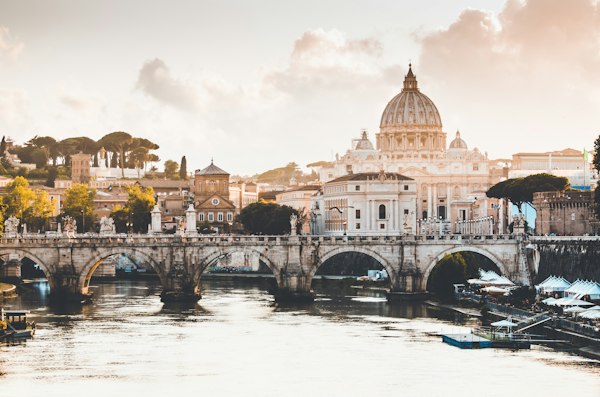
The bridge leading to the castle is worth its own paragraph. Ponte Sant'Angelo started out as Hadrian's Pons Aelius in 134 AD. In the 17th century, Pope Clement IX asked Bernini to dress it up, and Bernini lined both sides with ten marble angels, each holding an instrument of the Passion: the nails, the whip, the crown of thorns, the column. Bernini carved two of them himself, the Angel with the Superscription and the Angel with the Crown of Thorns, but the originals got moved indoors to Sant'Andrea delle Fratte because the popes decided they were too beautiful to leave out in the weather. The copies standing on the bridge now are by his students and they're no slouches. Cross it at sunset when the travertine goes orange and the castle looms up in front of you. It's hard to take a bad photo.
Visiting Castel Sant'Angelo Today
Today the castle is the Museo Nazionale di Castel Sant'Angelo, and the visit walks you through most of the building's lives in order. You enter through the original Roman ramp, the one that spiraled up through Hadrian's mausoleum to the burial chamber. From there you climb through the papal apartments, covered in Renaissance frescoes that Alexander VI commissioned. You pass the prison cells (tiny, grim, still genuinely unpleasant), the treasury rooms, and finally you come out on the rooftop terrace under the angel. St. Peter's dome sits directly across the river. The whole historic center opens up in every direction. Give it ninety minutes minimum. Closed Mondays, and buy tickets online if you can, because the line at the door moves like syrup.
This is what I love about the castle. It's not one thing. It's a Roman tomb wrapped in a medieval fortress wrapped in a Renaissance palace, and every pope, emperor, and besieging army left a mark on it. Next time you walk across the bridge, look up at the angel and take a second to think about what the bricks under your feet have seen. Nineteen hundred years. Still here. Still open for the afternoon.