Everyone walks up to the Colosseum knowing the basics: gladiators, lions, Russell Crowe. What most guidebooks don't mention is the stranger stuff — the flooded sea battles, the herb garden that grew in the ruins for a thousand years, the fact that the Popes basically turned the thing into a quarry for centuries. I've been walking people past it on our evening tour for years, and these are the Colosseum facts that actually make people stop and say "wait, what?"
1. They flooded it for naval battles
For the first few years of its existence, the Colosseum's arena floor could be flooded with water deep enough to float warships. The Romans called these staged sea battles naumachiae. We have ancient accounts of ships ramming each other while the crowd lost their minds in the stands. The engineering behind it was absurd: a network of channels tapped straight off the city's aqueducts, feeding water into the arena and draining it out again. Eventually they built the underground hypogeum beneath the floor, which made flooding impossible. But for that early window, Romans genuinely watched naval combat where gladiators would later die.
2. It was built by Jewish slaves
Vespasian started construction in 72 AD, and he paid for it with the gold looted from the siege of Jerusalem two years earlier. Tens of thousands of Jewish prisoners were shipped to Rome and forced into the labour — quarrying the travertine, hauling it across the city, hoisting the blocks into place. One of the ancient world's most famous buildings was built by conquered people on the wealth stolen from their destroyed temple. You don't hear that part often on the audio guides, and I think you should.
3. The opening party went on for 100 days
When Titus finally opened the Colosseum in 80 AD, he threw a festival that ran for 100 consecutive days. Ancient sources claim 9,000 animals were killed, along with untold numbers of gladiators and prisoners executed for the crowd. The scale was deliberate. His dad Vespasian had grabbed the throne in a civil war, and Titus needed Romans to remember the new regime for the spectacle, not the politics. It worked. They talked about those games for generations.
4. A secret herb garden grew inside it for centuries
This one's my favourite. Once the games stopped and the arena sat abandoned, the Colosseum turned into an accidental greenhouse. The warm sheltered interior created its own microclimate, and seeds blew in on the wind or came in with animals and people. By the 1800s, botanists had catalogued more than 400 plant species growing in the ruins. A lot of them weren't native to Italy. The best theory is that the seeds arrived on the fur and in the stomachs of African and Asian animals shipped in for the games, lay dormant in the manure, and sprouted once the Colosseum was overgrown. Some of those species didn't exist anywhere else in Europe.
5. There was a retractable roof
The Colosseum had a canvas awning called the velarium that stretched over the crowd on hot days. Think of the world's oldest stadium roof, just made of sailcloth and rope. Running it took a detachment of 1,000 sailors from the Roman navy, because they were the only people in the empire with the rigging skills. The support points are still there if you know where to look: those stone corbels around the top of the outer wall, each with a hole drilled into it for the wooden mast. I always point these out on the tour.
See the Colosseum at golden hour
Our evening twilight walk passes right by the Colosseum as the sun sets — our guides share these stories and more while you take in the view. Join the twilight walk →
6. The name has nothing to do with its size
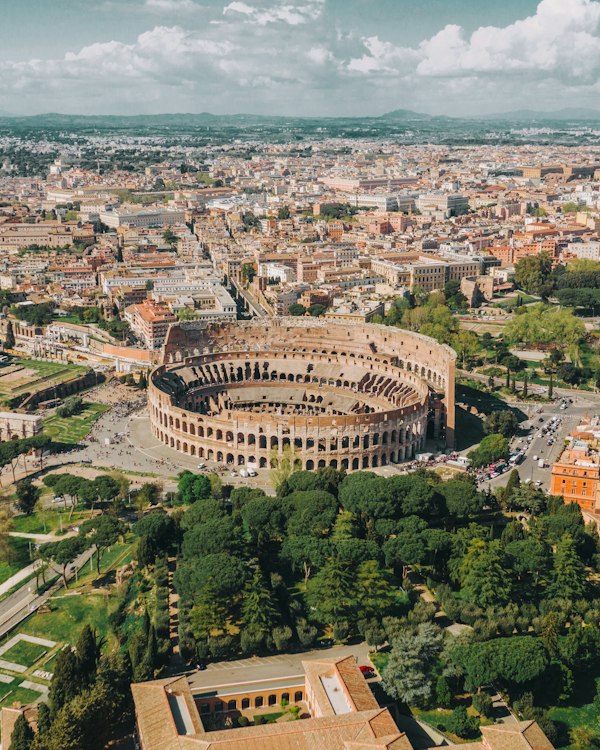
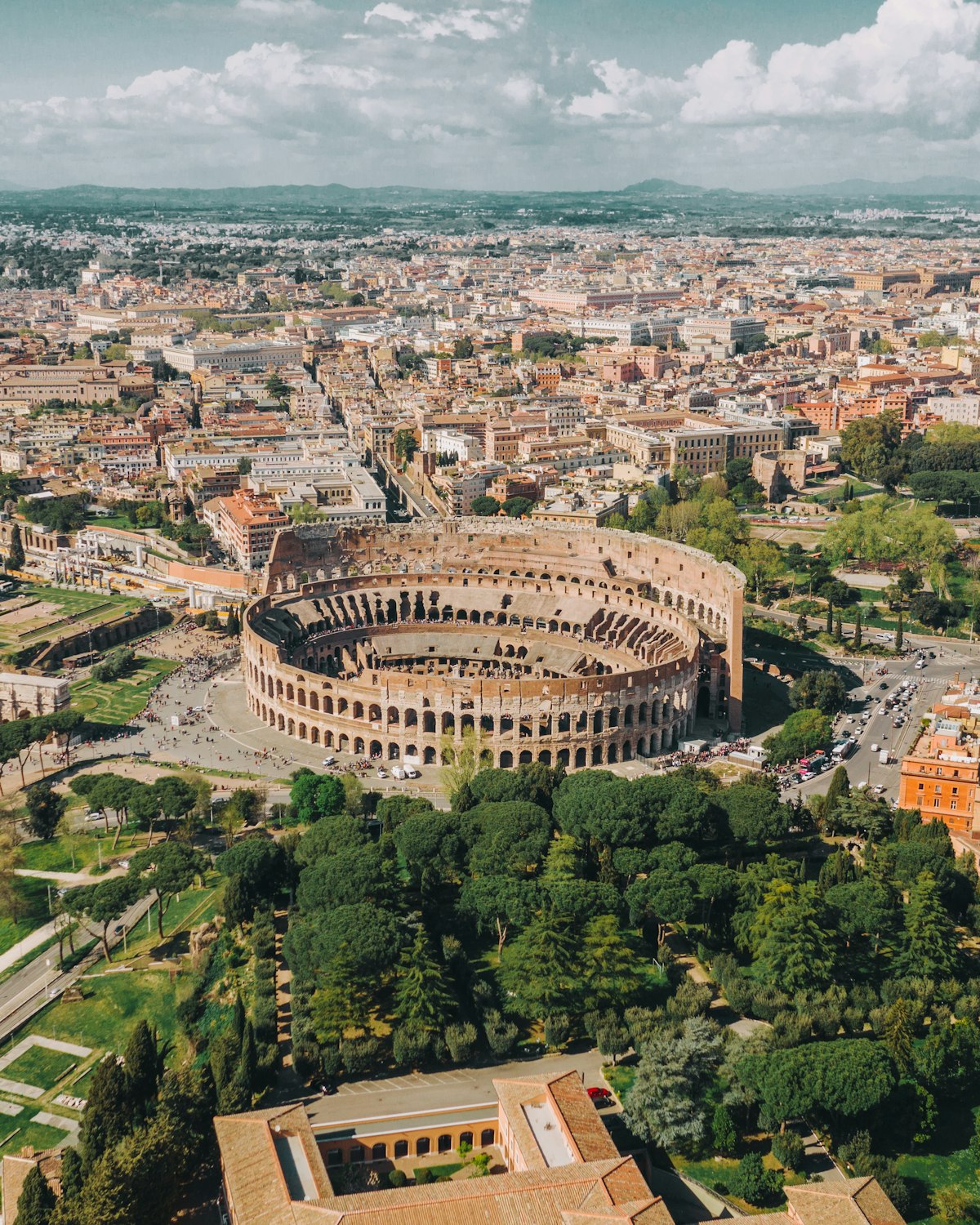
Officially it was called the Flavian Amphitheatre, after the Flavian dynasty that built it. The nickname "Colosseum" almost certainly comes from the Colossus of Nero — a 30-metre-tall bronze statue of Nero himself that used to stand right next door. After Nero died, his successors reworked the statue into a sun god (cheaper than melting it down) and it stayed there for centuries. Locals started calling the amphitheatre "the one by the Colossus," which got shortened to "the Colosseum." The statue's gone. The nickname stuck.
7. Most gladiators didn't actually die in the arena
Blame Hollywood. The movies make it look like every fight ended with a kill, but the data doesn't support it. Gladiators were expensive assets. Their owners, the lanistae, spent years and serious money training, feeding, and armouring them. Killing one off in every bout would have bankrupted the business in a month. The archaeological evidence and surviving tombstones suggest a death rate closer to 1 in 5, not 1 in 2. Losers often got "missio" — a pardon from the editor of the games if they'd fought well. Gladiators were more like pro athletes than doomed prisoners: fan followings, merchandise, even graffiti on the walls of Pompeii listing who was sleeping with them.
8. Rome used the Colosseum as a quarry
The barbarians didn't wreck the Colosseum. Romans did, slowly, over about a thousand years. Once the empire fell and the games stopped, the building became a convenient source of free stone. Travertine blocks got carted off for churches and palaces. The marble was burned down for lime. Chunks of the Colosseum are sitting inside St. Peter's Basilica, Palazzo Venezia, and the Ponte Sisto. That missing south wall — the one that gives the building its famously lopsided silhouette — was taken piece by piece, not blown out by an earthquake like the tour groups always say.
9. Women fought in the arena
Gladiatrices existed. Ancient writers reference them often enough that it wasn't some rare novelty. Emperor Domitian liked to stage fights between women, and sometimes between women and dwarves, which is about as Roman as it gets. There's a marble relief from Halicarnassus, now in the British Museum, showing two female gladiators mid-combat. A woman buried in London was found with gladiatorial grave goods. Septimius Severus eventually banned female gladiatorial combat in 200 AD, and you don't bother banning something that isn't happening.
10. The best part is underground
The hypogeum is the network of tunnels and chambers beneath the arena floor, and this is where the real engineering lived. Animal cages, holding rooms for gladiators, and 80 hand-operated lifts that could hoist a lion or a piece of scenery straight up through trapdoors into the middle of a fight. The crowd never saw any of it coming. One minute there's an empty arena, the next a bear is there. It stayed closed to the public for most of modern history. You can go down into it now with a proper ticket, and honestly it's the most impressive thing about the whole Colosseum.
Want more stories like these?
Our morning tour covers the Pantheon, Piazza Navona, Castel Sant'Angelo and more — with the same depth of hidden history. Book your spot →
The Colosseum isn't just a ruin. It's the ancient Romans laying themselves bare: what they were proud of, what they were cruel about, what they built to show off, what they built on the backs of people they'd conquered. Next time you stand in front of it, try to see past the selfie line. Picture the warships. Picture the 400 species of plants that shouldn't have been in Italy. Picture 80 trapdoors in the floor and a bear coming up through one of them. That's the Colosseum that doesn't make it into most guidebooks. Ours is the tour that tells you about it.