Capitoline Hill in Rome is the smallest of the seven hills, but honestly, it carries the most weight. This is where Roman senators worshipped Jupiter, where triumphal parades ended, and where the word "capitol" was born. Sit somewhere in the US Capitol or any state capitol building and you're using a word that started here. Today the hilltop is Michelangelo's. His piazza sits on top of the ancient foundations, and five hundred years later it still works. Campidoglio, Capitoline, same place. Most visitors give it twenty minutes on the way to something else. That's a mistake.
Capitoline Hill Rome: from ancient power to Renaissance beauty
In the ancient world this was the holiest ground in Rome. The Temple of Jupiter Optimus Maximus sat on the summit. Consuls took their oaths here. Triumphal processions ended here. Decisions that shaped the Republic got consecrated here. There was also the Temple of Juno Moneta, where Rome minted its coins, which is literally where our word "money" comes from. Then the empire fell. By the Middle Ages the temples were gone, the hill had turned to pasture, and locals were calling it Monte Caprino. Goat Hill. That's what it took — a few centuries of grazing livestock on the most sacred spot in the Western world. It took a pope with a guilty conscience and Michelangelo to fix it.
Michelangelo's vision: the Campidoglio
In 1536, Pope Paul III had a problem. Emperor Charles V was coming to visit, and the ancient sacred hill of Rome looked like a cow field. So he called Michelangelo, who was already in his sixties and already famous for the Sistine Chapel. Michelangelo's answer was weirder than anyone expected. A trapezoidal piazza. Not a square, not a rectangle. A shape that widens as you approach, so the space seems to open up and pull you in. Renaissance architects loved symmetry. Michelangelo bent the rules.
Three buildings wrap the piazza. Palazzo dei Senatori sits at the far end (it's still Rome's city hall today). The Palazzo dei Conservatori and Palazzo Nuovo flank the sides, mirror images of each other with those huge pilasters running the full height. Michelangelo drew all of it but didn't live to see any of it built. He died in 1564. The piazza was finished in the 17th century. The famous geometric pavement, that twelve-pointed star radiating out from the central statue, didn't actually get laid until 1940. Four hundred years between sketch and finished floor. Rome runs on its own clock.
The Marcus Aurelius statue
At the center of the piazza sits a bronze equestrian statue of Marcus Aurelius. Or rather, a copy. The original is from around 175 AD, and the only reason it still exists is a case of mistaken identity. Medieval Romans thought it was Constantine, the first Christian emperor. Melting down a statue of Constantine would have been sacrilege, so Marcus Aurelius kept riding through the centuries by accident. The original was moved inside the Capitoline Museums in 1981 because pollution was eating it alive. Stand in front of the copy and think about this for a second: almost every other large Roman bronze got melted for weapons or church bells. This one survived because people thought it was somebody else. That is the entire story of ancient Rome in one statue.
Visit Capitoline Hill at sunset
Capitoline Hill is a highlight of our evening twilight walk. Experience Michelangelo's piazza and the Forum views in golden-hour light with a local guide.
The Capitoline Museums: the world's oldest public collection
The Palazzo dei Conservatori and Palazzo Nuovo together make up the Capitoline Museums, which are the oldest public museums in the world. 1471. Pope Sixtus IV donated a group of ancient bronzes to the people of Rome and called it a museum, which nobody had done before. The collection is hard to believe. In Palazzo dei Conservatori you'll find the real Marcus Aurelius, the Capitoline Wolf (the she-wolf nursing Romulus and Remus), and the leftover pieces of a colossal Constantine statue. Just the head is taller than you are. The marble finger is the size of a small dog. Palazzo Nuovo has the Dying Gaul and the Capitoline Venus, among the best classical sculpture you'll see anywhere.
A glass-enclosed underground passage connects the two buildings and runs through the ancient Tabularium, which was Rome's state archive from 78 BC. Walk through it and you get a view directly over the Roman Forum, framed by massive Roman arches. People walk right past this entrance all the time. Don't.
The view over the Forum
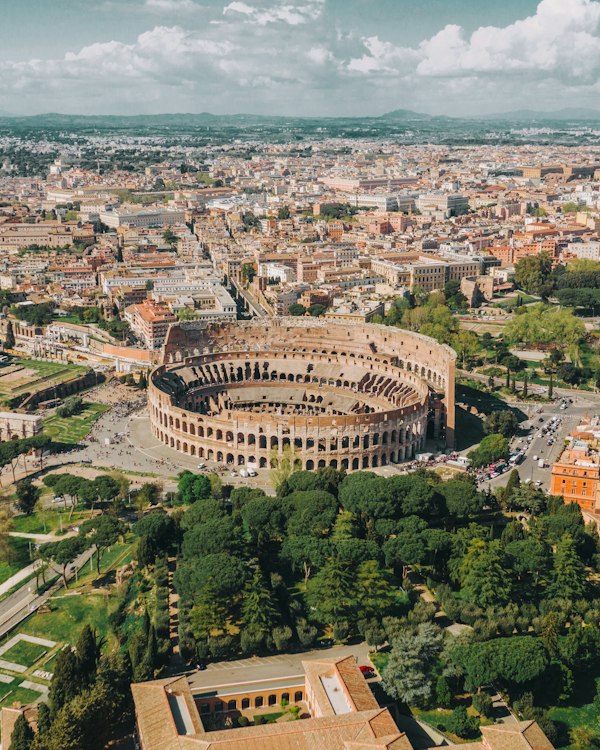
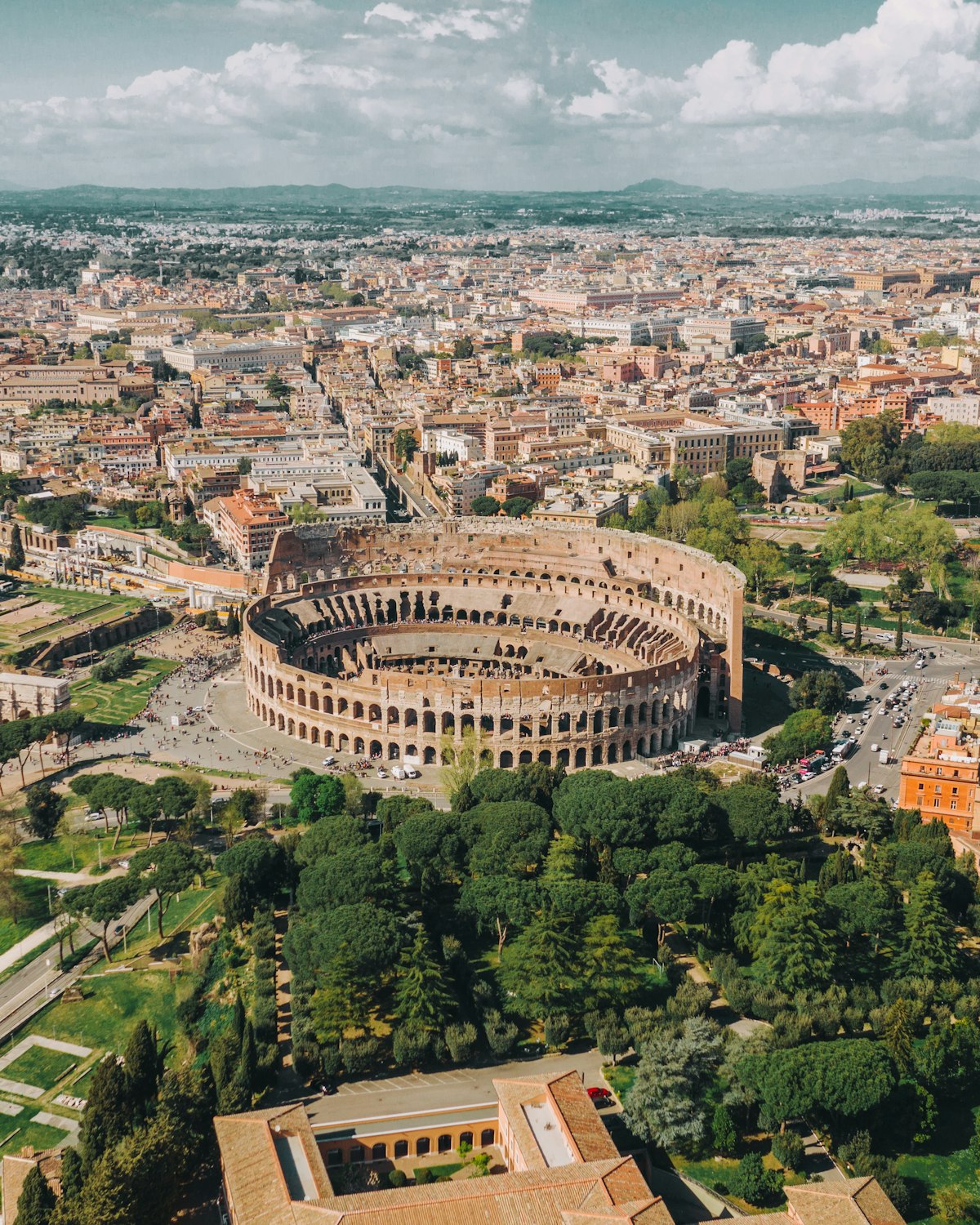
If you only do one thing on the hill, do this. Walk around behind the Palazzo dei Senatori. There's a terrace back there, and it's free. Below you the entire Roman Forum opens up: the arches, the temple columns, the Via Sacra where generals paraded after winning wars. The Colosseum is a little further out, sticking up above the rooftops. Come at sunset. I know it sounds like tour-guide filler, but the light does something to the old travertine that you have to see once. This is the part of my evening tour where I shut up for a minute and let people just look.
The Cordonata: Michelangelo's grand stairway
How you arrive matters here. Michelangelo designed the Cordonata as a wide, shallow-stepped ramp rising from the street up to the piazza. The steps are gentle on purpose. He wanted horses to be able to walk up them without scrambling. At the top, two giant statues of Castor and Pollux stand guard. As you climb, the piazza reveals itself slowly, the buildings appearing bit by bit over the lip of the stairs. It's choreography. Michelangelo wasn't just designing a piazza, he was designing how you'd feel walking into it.
Walk through Rome's ancient heart
Our evening tour winds from Rione Monti through the Colosseum and Trajan's Forum to Capitoline Hill — the perfect finale at golden hour.
Practical tips for visiting the Campidoglio
- The piazza is free and always open. Come at 3am if you want. It's floodlit at night and honestly that's when I like it most, when the crowds are gone.
- Museum hours. 9:30 AM to 7:30 PM daily, last entry 6:30 PM. Tickets required. For what's inside, the price is a steal.
- Best time to visit. Late afternoon if you want the Forum to glow. Early morning if you want the piazza to yourself. The museums are emptiest on weekday mornings around opening.
- Don't skip the back terrace. Walk around behind Palazzo dei Senatori for the Forum view. Free. Best photo you'll take in Rome, probably.
Capitoline Hill is where ancient Rome and Renaissance Rome sit on top of each other. In half an hour you can stand where senators swore oaths to Jupiter, look at a piazza drawn by the guy who painted the Sistine Chapel, and stare down at what's left of an empire. Small hill, enormous story. Every capitol building in the world is named after this one. Come see the original.